WORLD · AI & TECH · Analysis
US–China Diplomacy Meets AI’s Biggest Names: What Was Said at the White House?
Published
Donald Trump and Xi Jinping discussed AI before a White House state dinner whose guest list included some of the industry’s most powerful executives.
Their public remarks offered a diplomatic signal. The harder question is what follows for chips, investment and the rules governing AI.
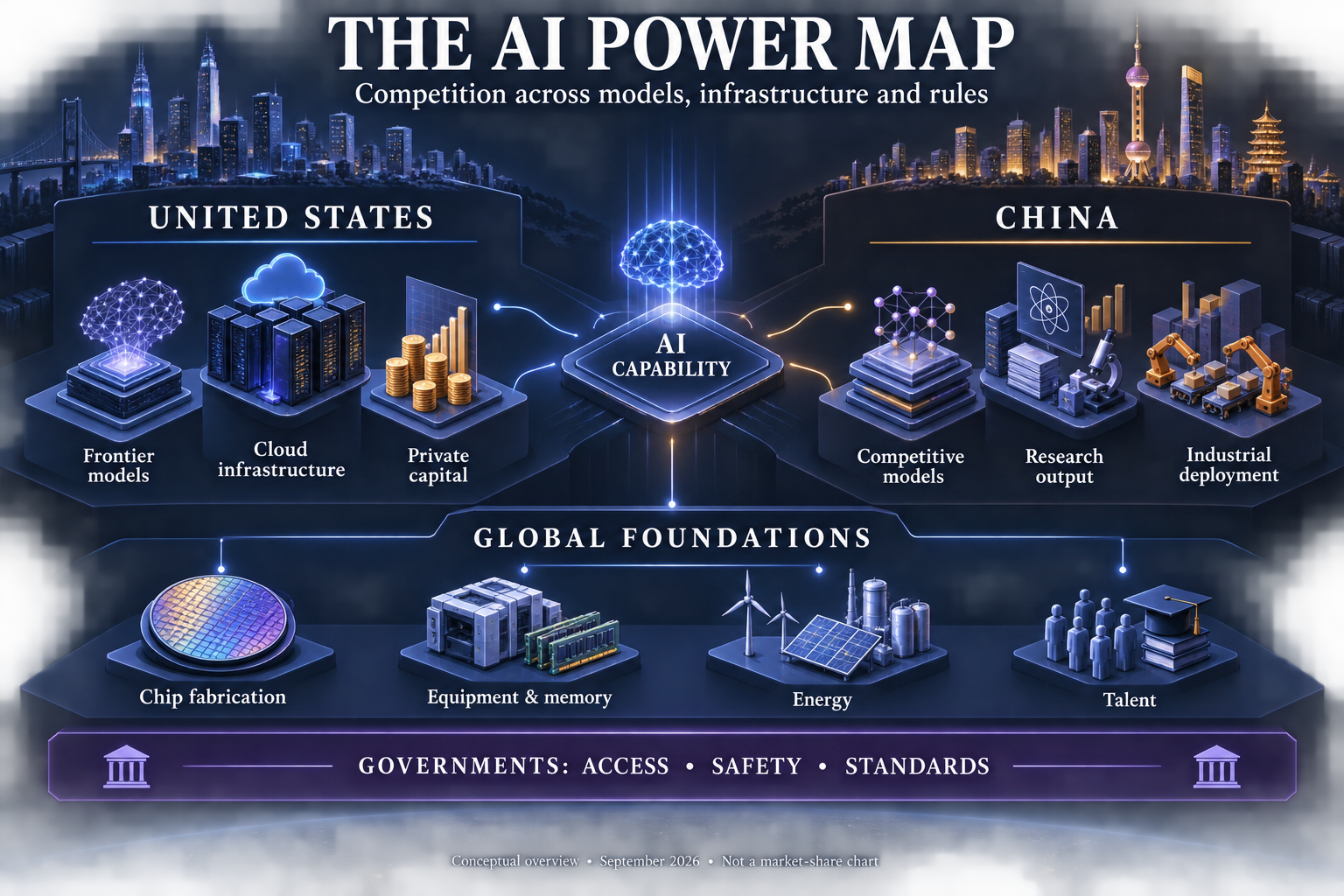
The AI race runs on more than models
A strong chatbot needs much more than good code. Someone has to fund the computing hardware, build the data centres and keep the electricity flowing. Those dependencies help explain why AI belongs on the diplomatic agenda.
Stanford’s 2026 AI Index describes a narrowing US–China model-performance gap. The United States leads in notable models and private investment; China leads in several measures of research output and industrial robot deployment.
Each measure captures a different kind of strength. The report largely covers 2025 and early 2026, so it should not be read as a ranking of where the two countries stand this week.
The map above simplifies a much wider network. Both countries depend on manufacturing, equipment, memory and skilled people beyond their borders. A policy affecting one part of that network can reach companies far from the negotiating table.
What happened on September 24?
President Donald Trump hosted Chinese President Xi Jinping for a state dinner at the White House on Thursday, September 24, following daytime talks. The Associated Press described a technology-heavy guest list and discussions spanning AI, trade and Taiwan. The evening in Washington fell on September 25 in Japan. Source: AP.
The White House had announced the dinner for the East Room as part of Xi’s September 23–25 visit. It followed Trump’s visit to China in May. Source: White House.
From the morning remarks to the evening toasts
Before the meetingTrump’s position
Reuters reported that Trump identified superintelligence as a major discussion topic in a social-media post before the meeting. He said he wanted to leave it exactly where it is
and added: Our guardrail is the DOJ!
He also portrayed China’s position as close to his own. That was his account; the post offered no joint policy text or terms for a freeze in AI development. Source: Reuters.
Daytime talksHuman control
CNN’s broadcast coverage attributed to Xi a call to keep AI under human control. The remarks were reported during the daytime talks. They left the mechanics open: who would intervene, under what conditions, and with what authority? Source: CNN transcript.
Evening toastsFriendship and compatible ambitions
In his evening toast, Trump acknowledged the countries’ different systems while emphasizing enduring connections between their people. He said they had never gotten along better
, according to AP. The toast struck a warm tone without spelling out a settlement of trade or technology disputes. Source: AP.
Xi’s toast, in the Chinese government’s published English version, argued that America’s national ambitions and China’s rejuvenation goals could be mutually reinforcing
. He described substantive discussions and common understandings, but gave no detailed AI commitments in the toast. Source: official Chinese transcript.
The executives were on the list. Their conversations remain private.
The White House guest list reported by Reuters included Nvidia’s Jensen Huang, OpenAI’s Sam Altman, Microsoft’s Satya Nadella, Google’s Sundar Pichai, Meta’s Mark Zuckerberg and AMD’s Lisa Su. It identifies the invited executives, but says nothing about what they discussed at the table. Source: Reuters guest list.
The reporting reviewed here contains no complete, attributable account of those private discussions. Claims about a deal or an executive’s position would need separate evidence.
DIPLOMACY × TECHNOLOGY
The companies on the guest list
Six technology companies named in the White House guest list reported by Reuters.
Our view: follow the rules, the capacity and the money
For the industry, the practical test is access: who can buy the hardware, raise the money and build enough capacity to serve customers? The next meaningful change needs to show up in an export licence, a working power connection or a rule someone can enforce.
Clearer rules could make it easier for companies to commit money. They would still have to pay for infrastructure, security and compliance.
Whether those costs reach customers, reduce margins or delay a project depends on the terms.
For a smaller business buying AI services, the useful questions are straightforward: will the service be available, what will it cost, and who is responsible when it fails?
What to watch next
Watch for policy documents with dates and named responsibilities, licensing decisions and company disclosures that commit money. A safeguard becomes easier to judge once it says who must act and how compliance will be checked.
Those details will tell us how much of the diplomatic warmth reaches the businesses building AI—and the people paying to use it.
Sources reviewed: September 25, 2026. Public statements, reported remarks and our editorial analysis are identified separately. This article does not claim access to private conversations.